
Mississippi County Court Records After Arrest
After a Mississippi County jail arrest, the first record is usually a jail or law-enforcement record. That record can show the arresting agency, booking information, alleged booking charges, and whether the person remains in custody. The formal court record is different. It starts when a complaint, information, indictment, citation, warrant case, or other case filing reaches the court. Missouri Case.net is the public statewide entry point for many court records, while the Mississippi County Circuit Clerk is the local office that maintains the court file.
The pathway is arrest, booking, first appearance or bond review, prosecutor filing, and then the circuit court case record. The Mississippi County Prosecuting Attorney decides whether and how to file local criminal charges. Once a case is filed, the court record may list the defendant name, case number, filing date, scheduled hearings, docket entries, bond orders, charge descriptions, charge levels, and dispositions. For custody and booking facts, use Mississippi County jail inmate records. For booking photos and release limits, use Mississippi County jail mugshots.
The official Missouri Case.net portal is the best starting point when the question is whether formal charges were filed after a jail arrest.
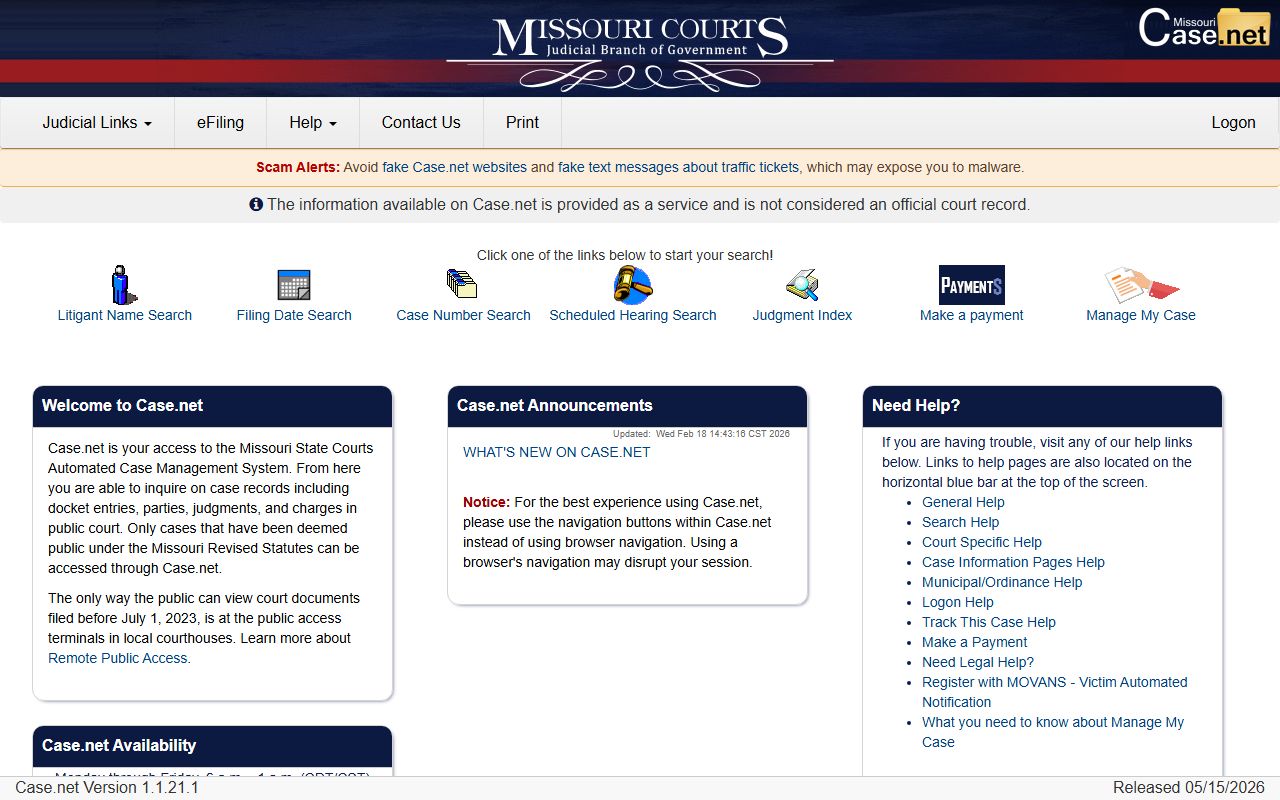
Case.net is a court-record tool, so it should be read with the jail and sheriff records path when custody or release status is also at issue.
Find Mississippi County Arrest Court Records
Case.net search works best after the prosecutor or court has created a case. A brand-new booking may not appear the same day. If the person was just arrested, first confirm custody through the Mississippi County Sheriff's Office and the Mississippi County Jail. When the case is filed, Case.net can be searched by litigant name, case number, filing date, or scheduled hearings and dockets. Name searches can miss records when a middle initial, suffix, spelling variant, or maiden name is used, so case number searches are more precise when a citation, warrant, or clerk reference is available.
- Open Missouri Case.net and choose the search path that matches the information available.
- Search by defendant name if no case number is known. Try full first and last name, then narrower spelling variants.
- Use case number search when a warrant, citation, bond paper, or clerk notice gives a file number.
- Review the docket for filing date, charge entries, bond events, and scheduled hearings.
- Contact the Mississippi County Circuit Clerk when a record is missing, sealed, older, or unclear.
Mississippi County court records after a jail arrest may also involve warrant matters, probation violations, municipal cases, or state criminal filings. Case.net does not replace the sheriff's booking information. It also does not operate as a full criminal-history background check. A public case search shows court case activity, while statewide criminal-history reports follow separate rules and should not be used as a substitute for a court file or a jail record.
| Case.net Search Field | Best Use | Limit to Remember |
|---|---|---|
| Litigant Name Search | Search by defendant name after filing. | Spelling, initials, and common names can affect results. |
| Case Number Search | Use a known court, warrant, or citation number. | Requires the number to be entered in the right format. |
| Filing Date Search | Narrow recent arrests after a case is opened. | A booking date may not match the filing date. |
| Scheduled Hearings / Dockets | Find upcoming court events and docket activity. | Schedules can change by court order or clerk update. |
Mississippi County Court Record Offices
The two local offices most tied to court records after a jail arrest are the prosecutor and the circuit clerk. The prosecutor files or declines charges, may amend charges, and handles criminal prosecution for the county. The clerk maintains the court record, receives filings, handles court forms and fees, and routes public case-file questions. A reader trying to learn whether charges were filed should start with Case.net, then use the clerk if the public portal does not answer the question.
The county's official prosecuting attorney page identifies Claire Poley and gives the charging office contact information used for Mississippi County criminal cases.
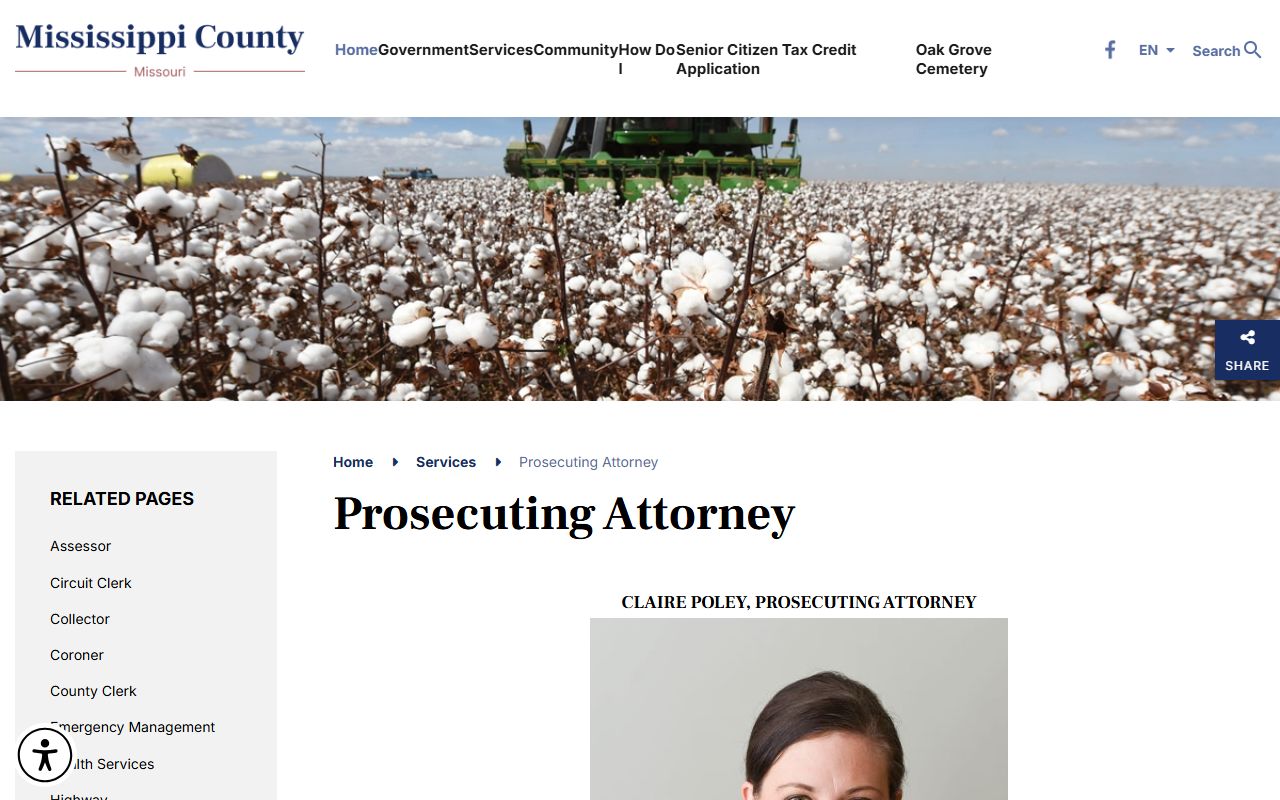
The prosecutor page explains the local charging role, but public case-file copies and docket questions usually route through the clerk.
Mississippi County Prosecuting Attorney
Claire Poley
200 N Main St., 1st Floor, PO Box 435
Charleston, MO 63834
Phone: 573-683-2146 Ext. 2
Direct: 573-683-2540
Fax: 573-683-6228
The Mississippi County Circuit Clerk page is the local court-record routing source for clerk contact details, forms, fees, and court-office hours.
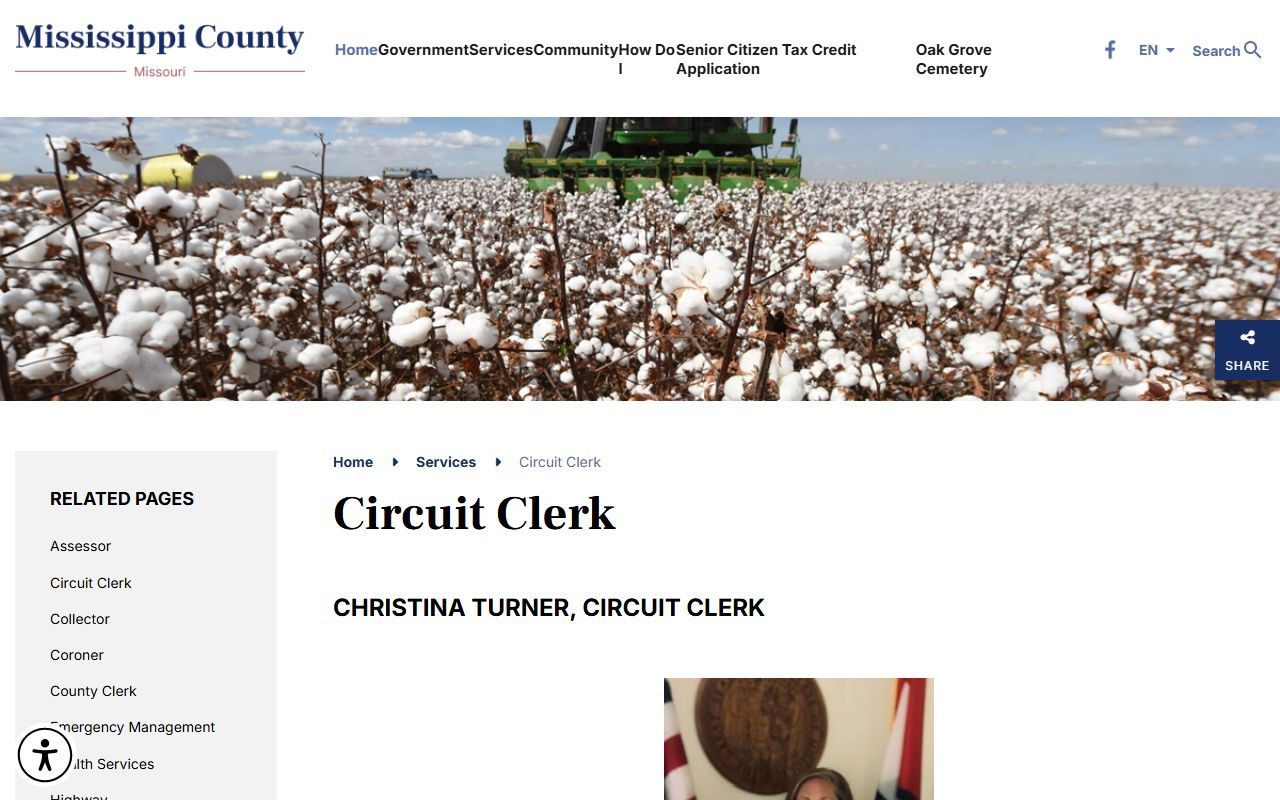
The clerk page is the better source for questions about case-file access, document copies, and court-record handling after a case exists.
Mississippi County Circuit Clerk
Christina Turner
200 N Main St., 2nd Floor
Charleston, MO 63834
Phone: 573-683-2146 Option 1
Direct: 573-683-2161
Fax: 573-683-7696
Monday-Friday 8:00 a.m.-4:30 p.m.
Mississippi County Charging Documents
Booking charges are often the first charges a family sees, but they are not always the final filed charges. The prosecutor reviews reports, witness information, officer statements, and the available law before filing the charging document. That filing turns an arrest event into a court case. In Mississippi County court records after arrest, the charging document may be a complaint, information, indictment, citation, or a later amendment. Each document has a different source and role, but all should be read as court filings rather than jail-roster fields.
| Document | Who Files or Starts It | What It Does | Why It Matters |
|---|---|---|---|
| Complaint | Prosecutor or authorized law-enforcement process | States the alleged offense and starts or supports a criminal case. | Often appears early after arrest, especially before later review. |
| Information | Prosecuting attorney | Formally charges offenses without a grand-jury indictment. | Common charging path for many Missouri criminal cases. |
| Indictment | Grand jury | Charges a case after grand-jury action. | Can appear in serious or selected felony matters. |
| Amended Charge | Prosecutor with court process | Changes, adds, reduces, or corrects an existing charge. | Explains why the filed charge may differ from the booking charge. |
Read the charge line with the docket. A charge can be filed, amended, dismissed, or resolved at different times. The active charge list may not match the first allegation recorded at the jail. If the case has a bond order, hearing notice, warrant entry, or disposition, those entries help show the current stage of the court record.
Mississippi County Charge Status
Charge status describes where a specific charge stands in court. It is not the same as guilt. A pending charge is still being processed. A dismissed charge no longer proceeds in that case. A reduced charge may replace a more serious allegation. A conviction requires a guilty plea, verdict, or other qualifying outcome. Because criminal cases can have more than one count, each count may have its own status and disposition.
| Status | Plain Meaning | Record Reading Tip |
|---|---|---|
| Pending | The charge or case is still active. | Check the next hearing and bond entries. |
| Amended | The prosecutor changed the charge wording, level, count, or related filing. | Compare the new filing with earlier docket entries. |
| Reduced | The charge was lowered to a lesser offense or different level. | Look for plea, amendment, or negotiation entries. |
| Dismissed | The charge was ended by court or prosecutor action. | Do not read a dismissed charge as a conviction. |
| Nolle Prosequi | The prosecutor declined to proceed on that charge. | Other counts or related cases may still remain. |
| Disposed | The court has recorded an outcome for that charge or case. | Open the disposition entry for the exact result. |
Note: A booking allegation can be replaced by a different court filing after the prosecutor reviews the case.
Bond Orders After Mississippi County Arrest
Bond is controlled by court order. The Mississippi County Jail may be able to say whether a person is in custody, whether a bond amount appears, or whether a hold prevents release. Case.net and the court file are better for later bond changes, bond conditions, and hearing history. Bond can be set at or near first appearance, then changed after later hearings. A no-bond hold, probation or parole detainer, another county warrant, ICE detainer, or federal hold can block release even when a local bond amount appears to exist.
| Bond Type | How It Works | Where to Confirm |
|---|---|---|
| Cash Bond | Money is posted directly under court or jail payment rules. | Call the jail or clerk before traveling. |
| Surety Bond | A licensed bondsman guarantees appearance. | Confirm surety acceptance for that case. |
| Recognizance / PR | Release is based on a promise and conditions. | Look for the judge's order and release terms. |
| No-Bond Hold | Release is not allowed until a court or agency changes the hold. | Ask about warrants, detainers, and judge orders. |
| Detainer | Another agency requests custody or notice. | Check DOC, ICE, federal, or another county source. |
Warrants in Mississippi County Court Records
No official Mississippi County sheriff active-warrant search page was located in the county website sources reviewed. That makes Case.net, the sheriff's main phone channel, and clerk contact the practical route for public warrant-related court records. A bench warrant may appear in a court docket when a person misses court or fails to comply with an order. An arrest warrant can lead to booking at the Mississippi County Jail. A search warrant is different and does not function as an inmate lookup record.
For a local warrant question, call the Mississippi County Sheriff's Office at 573-683-2111 for custody or law-enforcement routing, search Case.net by name or case number, and contact the circuit clerk if the public court record is unclear. Anyone who believes an active warrant exists should speak with an attorney before appearing at a law-enforcement office. Website searches do not clear a warrant, recall a warrant, post bond, or change court conditions.
Mississippi County Charges vs Convictions
An arrest, a jail booking, a filed charge, and a conviction are separate events. A person can be arrested and never charged. A person can be charged and later have the charge dismissed. A conviction is an outcome after a guilty plea, verdict, or other qualifying court result. Mississippi County court records after a jail arrest should be read with that sequence in mind, especially when comparing a jail booking entry to a later Case.net disposition.
| Point of Comparison | Charge | Conviction |
|---|---|---|
| Stage | An accusation filed in court or recorded at booking. | A final or qualifying guilty outcome. |
| Proof Level | Based on probable cause or prosecutor filing decision. | Requires plea, verdict, or court finding. |
| Record Meaning | Shows what was alleged at that stage. | Shows the court outcome on the charge. |
| Can Change | May be amended, reduced, or dismissed. | May be appealed, set aside, or affected by later relief if allowed. |
Mississippi County Sealed or Expunged Records
Missouri public access rules presume many public governmental records are open, but the rule has limits. RSMo 610.011 states the Sunshine Law's open-record policy. RSMo 610.023 governs custodians and records-request access. RSMo 610.100 addresses arrest reports, incident reports, and investigative reports. Court records after arrest may also be restricted by sealing, expungement, juvenile confidentiality, victim protections, or active investigation rules.
| Access Result | Sealed Record | Expunged Record |
|---|---|---|
| Public Visibility | Hidden or limited from ordinary public access. | Closed or treated under the expungement order. |
| Legal Source | Court order or law limiting access. | RSMo 610.140 for eligible arrests, pleas, trials, or convictions. |
| Who May Still See It | Certain courts, agencies, or parties may retain limited access. | Access depends on the statute, order, and requesting agency. |
| Practical Step | Ask the clerk how a sealed file is handled. | Use the court order with the originating agency and clerk. |
Juvenile records are different: RSMo 211.321 treats juvenile records differently from adult jail and adult criminal court records, so juvenile detention information should not be handled like a public adult inmate search.
Criminal History and Case Search
Case.net, jail records, arrest reports, and criminal-history checks serve different purposes. Case.net is a court case search. A sheriff record request seeks releasable records from the agency that created them. A statewide criminal-history report follows a separate process and may include different rules, identifiers, fees, or access limits. Do not treat a casual court search as a complete background check, and do not treat an arrest as proof of guilt.
Important: Mississippi County Inmate Population is not a consumer reporting agency, and records here cannot be used for employment, credit, housing, insurance, or any FCRA-covered decision.
Restricted Mississippi County Court Records
Some court records after arrest are not fully public. A record may be sealed by court order, limited because it involves a juvenile, affected by an expungement order, or withheld in part because the underlying law-enforcement material is investigative rather than an arrest report. A public portal may also omit document images while still showing docket text. When Case.net does not show the expected record, use the circuit clerk for court-file access questions and the sheriff for the jail or arrest-report request path.
Mississippi County also has more than one custody system that readers may confuse. The Mississippi County Jail handles adult local custody after arrest. Southeast Correctional Center is a Missouri Department of Corrections prison for sentenced state prisoners. Federal and immigration custody use BOP, U.S. Marshals, or ICE channels, and the county research did not locate a federal prison or ICE detention facility inside Mississippi County. These systems may connect through holds or detainers, but their records are not the same file.